The Rise of Micro Generations: Zoomers 1.0 vs. 2.0
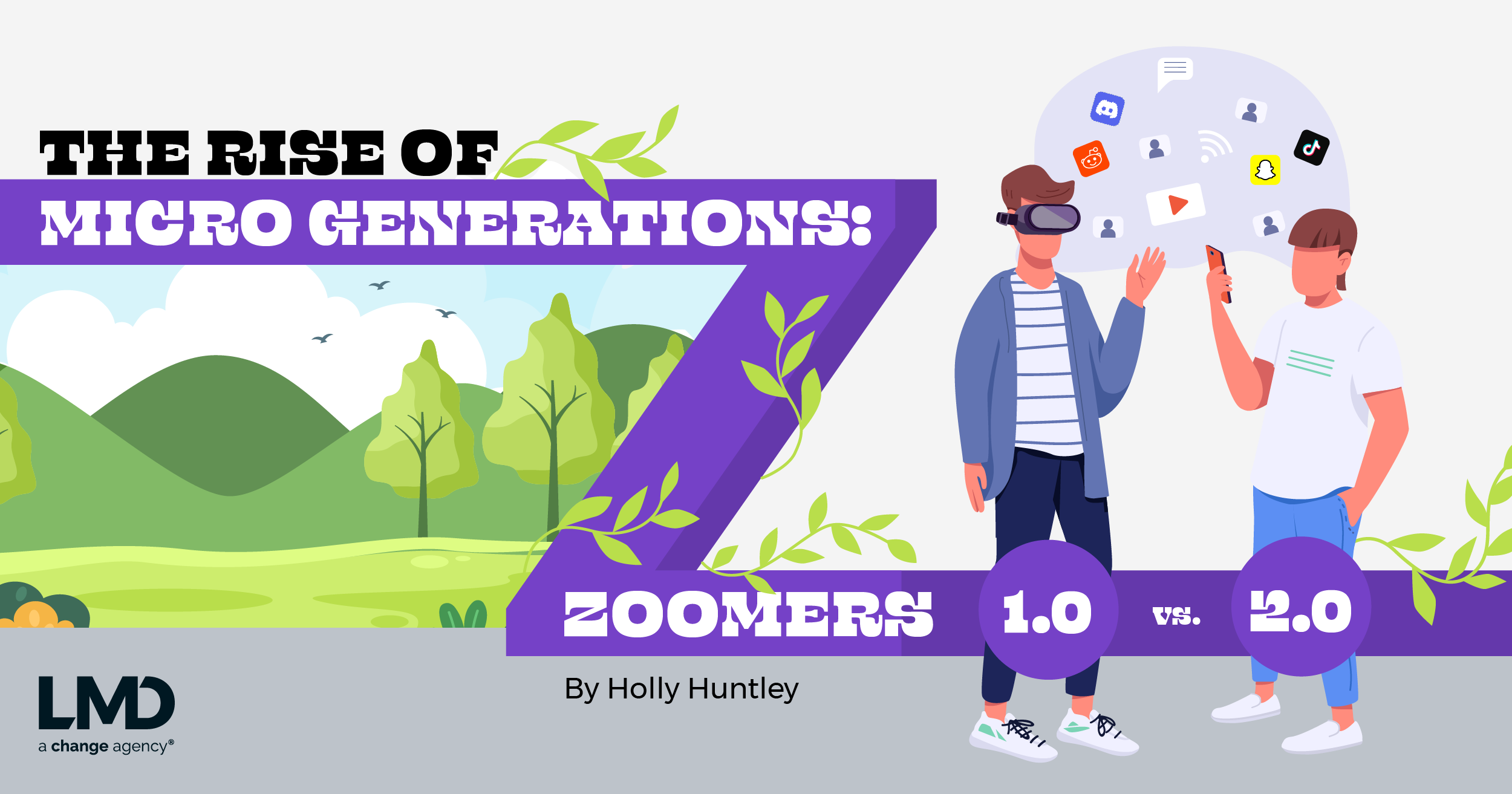
This is a tale of two Zoomers in my life, my sons Reid and Andrew.

Webster’s dictionary includes the word Zoomer to describe a member of Generation Z (born between 1997 and 2012).
In our marketing work at LMD, we find that deeper segmentation is needed to understand the unique traits of “micro generations,” a more granular view of the broader generational cohorts typically studied by demographers. Zoomers are one example.
Reid, born in 2001, is considered a Zoomer 1.0, and Andrew, born in 2005, is considered a Zoomer 2.0. Reid graduated high school before the pandemic and Andrew graduated high school after the pandemic. COVID is typically an important line of demarcation for this microgeneration.
Both are digital natives, but they did not have smartphones or tablets at an early age, but were among the first group of teens to have smartphones in high school. Unfortunately, I think this social experiment failed, and now the pendulum is swinging back as schools are banning phones in school. Phones at school led to fewer meaningful social interactions and a negative impact on attention spans.
Reid was an early adopter on Club Penguin and Minecraft and selected Reddit as his preferred social channel and Discord as his favorite messaging app. Andrew was an early adopter on TikTok and Snapchat, which connects him to a group of friends daily on demand. Both prefer YouTube as their streaming channel and information source. They do not sit down to watch TV shows or movies. However, they do stream movies or shows and watch them virtually alongside their friends.
Reid has a traditional 9-5 job as a software engineer. As someone early in his career, he appreciates his hybrid work schedule with three days in the office and two days remote. Andrew, on the other hand, prefers working in the gig economy. In fact, he and his friends will deliver DoorDash orders together as a social activity. Speaking of DoorDash, Andrew and his college roommates have everything delivered from DoorDash, including groceries or random household items and supplies.
Many in this generation have also discovered the importance of “third places” to maintain their sanity in this digital world. A third place is an alternative to home and school/work. Reid discovered hiking as his third place, and Andrew became hooked on fishing during the pandemic. This was a positive outcome of the COVID pandemic as they sought out fresh air activities. They both tell me doom scrolling is the one bad habit they would love to give up and recognize the downsides. The antidote is the great outdoors. This is such a common phenomenon that Webster’s dictionary added the idiomatic phrase “touch grass” this year, meaning to participate in normal activities in the real world vs. online.
Speaking of sanity, this generation has reportedly dealt with more mental health struggles, but the silver lining is that this age group is also more open to talking about mental health and supporting each other when they have challenges. Their supportive communities of friends are really refreshing to see. I applaud them for their transparency and openness.
Finally, Zoomers have their own language that has developed as a form of online shorthand for texting or terminology based on exposure to viral reels. All of this has had an impact on modern-day linguistics as it creeps into our everyday communications. Dictionaries are keeping up by increasingly adding the language of Gen Z.
My hot take: This generation has a lot of rizz. It is no wonder that many of them are vibing with swagger. But when I message them, and they put me on read, no cap, that really makes me sus. LMKWYT!