

White Paper.
Making it a Joke: How Serious Organizations Can Use Humor to Communicate
We won’t sugarcoat it–it’s hard to stand out on social media. Your organization is fighting a tide of shocking, hilarious, heartwarming, fascinating, and/or gorgeous content. It can seem like an upward battle to churn out noteworthy content quickly (and hopefully, inexpensively).
Contents


Here’s a fun fact:
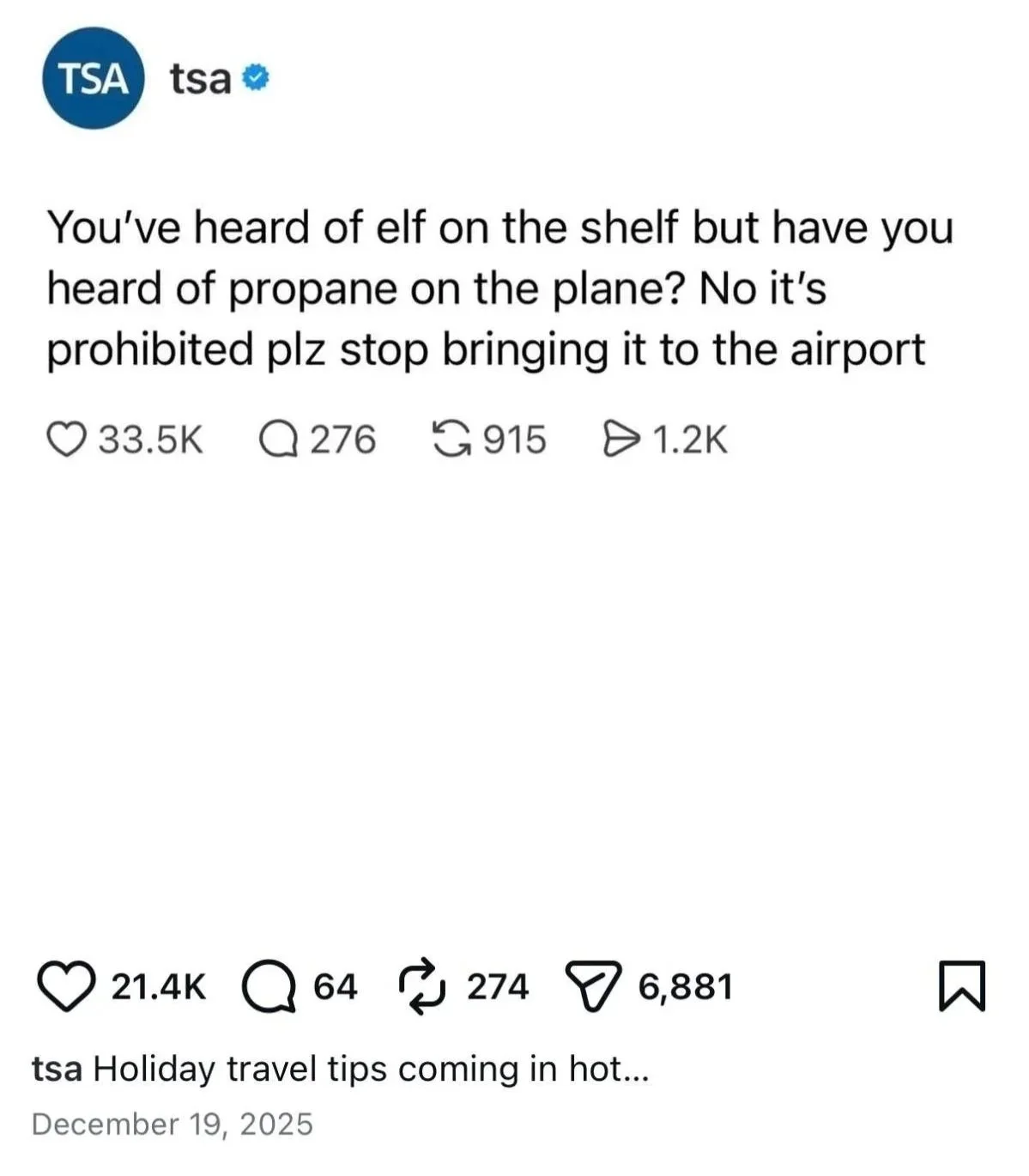
The Transportation Security Agency (TSA) has over 1.5 million followers on Instagram. Their posts almost always get between 10,000 to 20,000 likes.
A post about banned liquids on planes got over 6,000 shares. For most people, when you walk through airport security and see a ruling on liquids, your first thought is not “Wow, I can’t wait to share this with my friends and family.” So why is a government agency getting such high engagement?.
It’s because the TSA has mastered humor in communications. And that’s not easy. Humor is probably the hardest tone to deliver. It’s subjective between people and cultures, often relies on up-to-date pop culture knowledge, and can veer into controversial territory without careful guidelines. There’s a reason many organizations don’t attempt humor. Nobody wants their joke to fall flat, or worse, offend. And for organizations like the TSA dealing with serious topics and missions, it can be even more complicated.
But for the TSA, and some other organizations, it works—so let’s look at why you should consider humor, how to use humor, and how to set guidelines for creating humorous content.
Why Use Humor?
In short, because of science. Research in behavioral science and communications consistently shows that humor can increase participation and memory recall in learning.
For organizations, the goal of humor isn’t entertainment; it’s comprehension and compliance. It’s comprehension and compliance. Like hiding vegetables in a child’s macaroni and cheese, you’re turning something important into something your audience loves consuming.
An Entertaining Post:
Stands out on a crowded feed.
Gets fully read (so people make it to the punchline).
Encourages sharing.
Sticks in your audience’s memory.
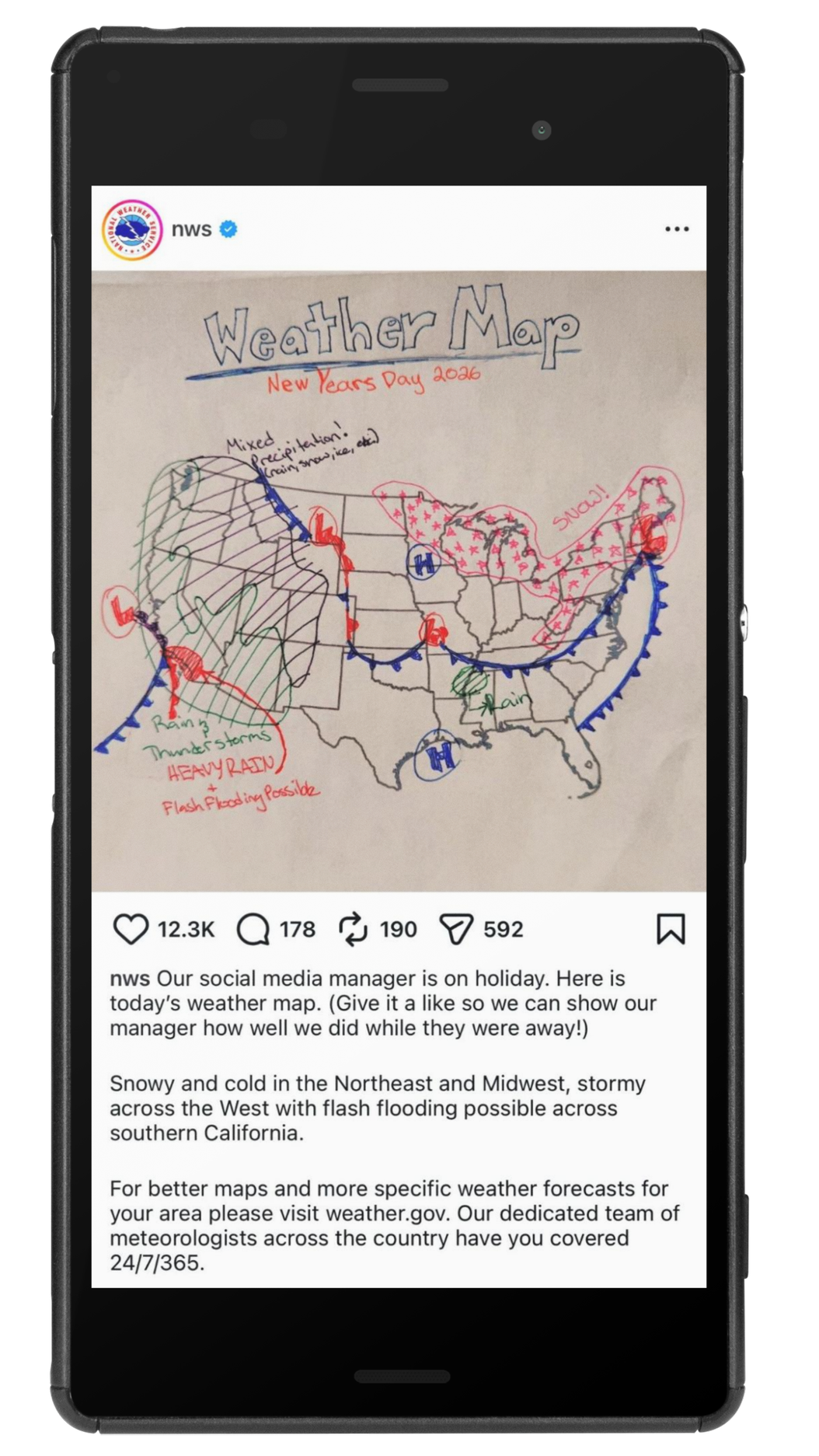
Take this National Weather Service (NWS) post. The hand-drawn map makes someone swiping pause—why is the NWS resorting to markers and paper? Readers find out the joke (a social media manager leaving their office unsupervised), but also an important message–severe weather warnings across the country. A traditional radar map would likely not have gotten the attention and distribution this one does.
How Do I Use Humor?
Spoiler Alert: Carefully. It’s easy to master appropriate humor for your organization, but there are some strict ground rules that should not be crossed.
DO
BE SILLY VS. EDGY. Cheesy, corny—engage your “dad jokes”. Make a thirteen-year-old roll their eyes and send your pun to their friends (they are still absorbing your message)!

KEEP AN EYE OUT FOR TRENDS. Is there a funny viral trend that your office or program can join in on? Is there a reality TV show you can use for a meme? Topical content gets picked up more frequently.
MATCH YOUR HUMOR TO YOUR BRAND’S IDENTITY. Social media is generally more casual than your other communications channels, but should still feel like one voice.
CROWDSOURCE YOUR TALENT. Everyone’s a comedian. Encourage people in your organization to submit ideas, and focus-group your jokes.
MOVE FAST. Many jokes rely on capturing a moment in time. If a meme or viral trend is happening now, execute it now. Waiting until next month’s social calendar will be too late.

DON’T
TARGET A GROUP OF PEOPLE, TRAGEDIES, OR POLITICALLY SENSITIVE TOPICS. We should be laughing together, not at each other. Nobody should feel attacked or made to feel lesser than others.
DO A 180. You don’t need to switch to all humor—in fact, this can be jarring. Start slow, and find a ratio of humor to serious posts that works for you and your audience.
REPLACE THE MESSAGE, SUPPORT IT! Don’t lose your call to action (CTA) in the joke. Start with what you want your audience to take away—then craft a joke around that.
TAKE A RISK. When humor is used for education, and your organization’s reputation is on the line, it’s better to be safe than sorry.
FORGET YOUR AUDIENCE. Some jokes are universal, but others might be more demographically specific (especially generationally).

-
Is the core message still clear without the joke?
-
Does this joke target behavior or objects—not individuals or groups?
-
Would this message still feel appropriate during a serious news cycle?
-
Does the content and visuals still align with your brand?
-
Does this joke encourage people to take our desired action?
HERE’S A QUICK CHECKLIST BEFORE YOU HIT POST
How Does My Organization Find Its Sense Of Humor?
Every organization should have a brand voice and tone. This is the style your organization uses to deliver communications. You can learn a bit about your brand voice here.
Your brand voice should be consistent, but not necessarily in formality. Your press releases are likely more formally written than your website, and your social media is more casual than your job postings. Just as we vary our formality as people while still remaining “us,” your organization can develop a sense of humor for its persona.
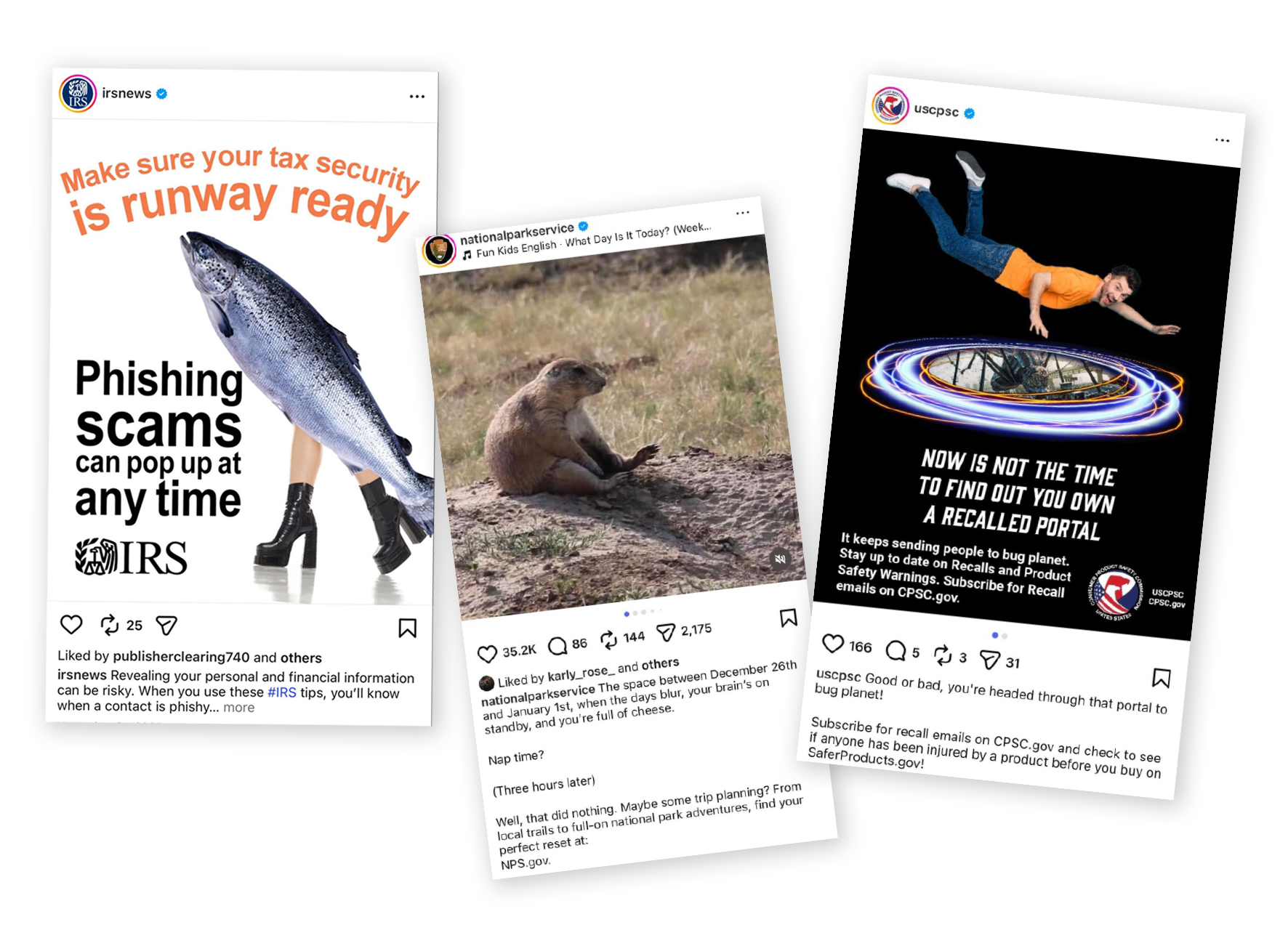
The National Parks Service’s Tone and Voice are competent, educational, and friendly.
NPS’ humor is best described as “your favorite science teacher”—animal puns, sharing silly park facts and photos, and deadpan humor about the realities of breaking important safety rules.

The Transportation Security Agency (TSA)’s Tone and Voice are helpful, firm, and reliable.
The TSA’s humor is “we’re all in this together.” They share funny videos of their agents and dogs bonding with travelers, travelers’ (low-stakes) attempts at getting odd things past security, and jokes about how to make your travel easier.

The Internal Revenue Service (IRS)’s Tone and Voice are educational, resolute, and comprehensive.
The IRS’s humor is all about “wait—what?” Their copy is generally strictly factual, but their imagery is absurd and eye-catching. This is a fun juxtaposition from their sensible and pragmatic language—kind of like a straightforward accountant wearing a goofy tie.

Your “humor persona” might be dad jokes, puns, sharing funny and interesting facts about your area of expertise, or blunt observations your audience will laugh along with.
Think about your audience's shared interests and experiences. Chart their overlap.
What entertainment do they consume? What shared hobbies do they have? How do they engage with your organization? What frustrations does your organization alleviate for them?
As an accounting firm, we know our audience dreads tax season (luckily we are here to make it easy!).
As a Baltimore-based company, we know our stakeholders take the Ravens seriously.
As a library system, we know our patrons have a lot of opinions on the best movie adaptations of books.
Imagine your organization as a character.
Think about your team’s personality, strengths, interests, and shared experiences for this.
Our waste management division is a grumpy but lovable public servant, who’s tired of people putting trash in the recycling and can’t resist a good pun.
Our law firm is an outgoing professional who loves to educate in clever short-form video content and hop on social media trends.
Our pediatrics nonprofit is a friendly physician who knows that parenthood can be stressful—they share topical child health and safety tips with humor and heart.

Try it out
Start small, test thoughtfully, learn quickly, and refine your approach over time. Finding your organization’s sense of humor is about understanding your audience, embracing your shared experiences, and allowing some humanity to show through your communications.
The key is intentionality: grounding jokes in your brand voice, respecting your audience, protecting the core message, and knowing when not to be funny. Humor should never replace your mission, it should amplify it.
At the end of the day, people engage with voices that feel human. And sometimes, the most effective way to be taken seriously is to not take yourself too seriously.
Looking for Support?
LMD has extensive experience building blogs for organizations. From lending support to the planning and implementation, to completely handling the execution, we can work with your team to make it easy. We’re here to help.